

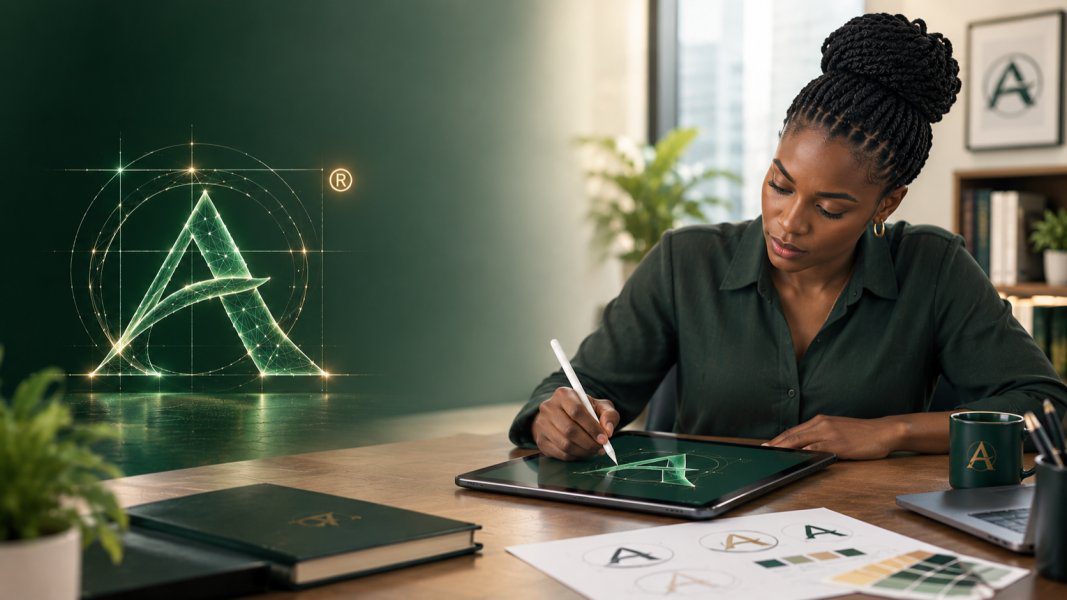
Generative design tools now let a business produce a polished logo in minutes. For many Kenyan startups and SMEs, that speed is attractive. Yet a logo is more than artwork; it is the face of your brand in the marketplace. Before building a business identity around an AI created mark, it is worth understanding what Kenyan law protects, what it may not, and where the risks lie.
Trademark and Copyright: Two Different Questions
A logo can attract two forms of protection. Copyright protects the artwork as an original artistic work. Trademark protection, on the other hand, protects the logo as a badge of origin that distinguishes your goods or services from those of competitors.
Under the Trade Marks Act (Cap. 506), registration through the Kenya Industrial Property Institute (KIPI) turns on whether the mark is distinctive and does not conflict with existing marks. The Act does not ask who, or what, drew the design. In principle, therefore, an AI created logo can be registered as a trademark if it meets the statutory tests.
Copyright is more complex. Kenya’s Copyright Act (Cap. 130) provides that for computer generated works, the author is the person who made the arrangements necessary for the work’s creation. This gives Kenyan businesses a potential foothold that some other jurisdictions deny, although local courts have yet to test how the provision applies to modern generative AI.
Case Brief: Thaler v Perlmutter
Court: United States Court of Appeals for the District of Columbia Circuit, 130 F.4th 1039 (2025)
Facts: Dr Stephen Thaler sought to register copyright in a visual artwork titled “A Recent Entrance to Paradise.” He acknowledged that the image was created by his AI system without traditional human authorship, but argued he should still be recognised as the author because he owned and programmed the system.
Issue: Can a work generated autonomously by a machine receive copyright protection, with the machine named as author?
Holding: The D.C. Circuit ruled on 18 March 2025 that copyright protection requires human authorship, so Thaler’s AI generated work could not be registered. On 2 March 2026, the United States Supreme Court declined to hear the appeal, leaving that ruling intact.
Limits of the decision: The case did not settle whether AI assisted works in general can be protected, nor how much human involvement is enough when AI tools are used.
Relevance for Kenya: The decision is not binding here, but it is persuasive and signals the global direction of travel. A Kenyan business trading abroad may find its AI created logo registrable as a trademark yet unprotected by copyright in key export markets. That gap matters when a competitor copies the artwork in a way that falls outside trademark infringement.
Practical Risks to Consider
- Lack of distinctiveness. AI tools are trained on existing imagery and often produce generic or familiar designs. A mark that resembles common industry symbols may be refused for lacking distinctive character.
- Similarity to existing marks. Because outputs draw on patterns from existing works, an AI logo may unintentionally resemble a registered trademark. Section 15 of the Act bars registration of marks identical or confusingly similar to earlier marks, and third parties may oppose your application within 60 days of publication in the Industrial Property Journal.
- Platform terms of use. Some AI platforms retain rights in outputs, grant only limited licences, or allow the same design to be generated for other users. Ownership of your logo may depend on terms you accepted without reading.
- Weak ownership evidence. In a dispute, you may need to prove how the logo was created and that you control it.
Steps to Protect Your Brand
- Treat the AI output as a draft. Having a human designer refine and adapt the concept strengthens both distinctiveness and any copyright claim.
- Conduct a trademark search on the KIPI register, and in any foreign markets you plan to enter, before adopting the logo.
- Review the AI platform’s terms to confirm you own, or hold exclusive rights to, the output.
- Keep records of prompts, drafts, and human modifications as evidence of your creative input.
- File your trademark application early, in every relevant class of goods and services.
Conclusion
AI has made logo creation faster, but it has not made brand protection automatic. Trademark registration remains available for AI created logos in Kenya, provided the mark is distinctive and original in the marketplace. Businesses that combine AI tools with human creativity, careful searches, and good record keeping will be best placed to own their brand with confidence.
This article is for general information only and does not constitute legal advice.